
A business spends ₹50,000 every month on advertising. Clicks increase, website traffic grows, but sales remain flat.
The immediate reaction is often to blame the advertisement.
But the ad may have completed its job successfully. The actual problem could exist later in the customer journey.
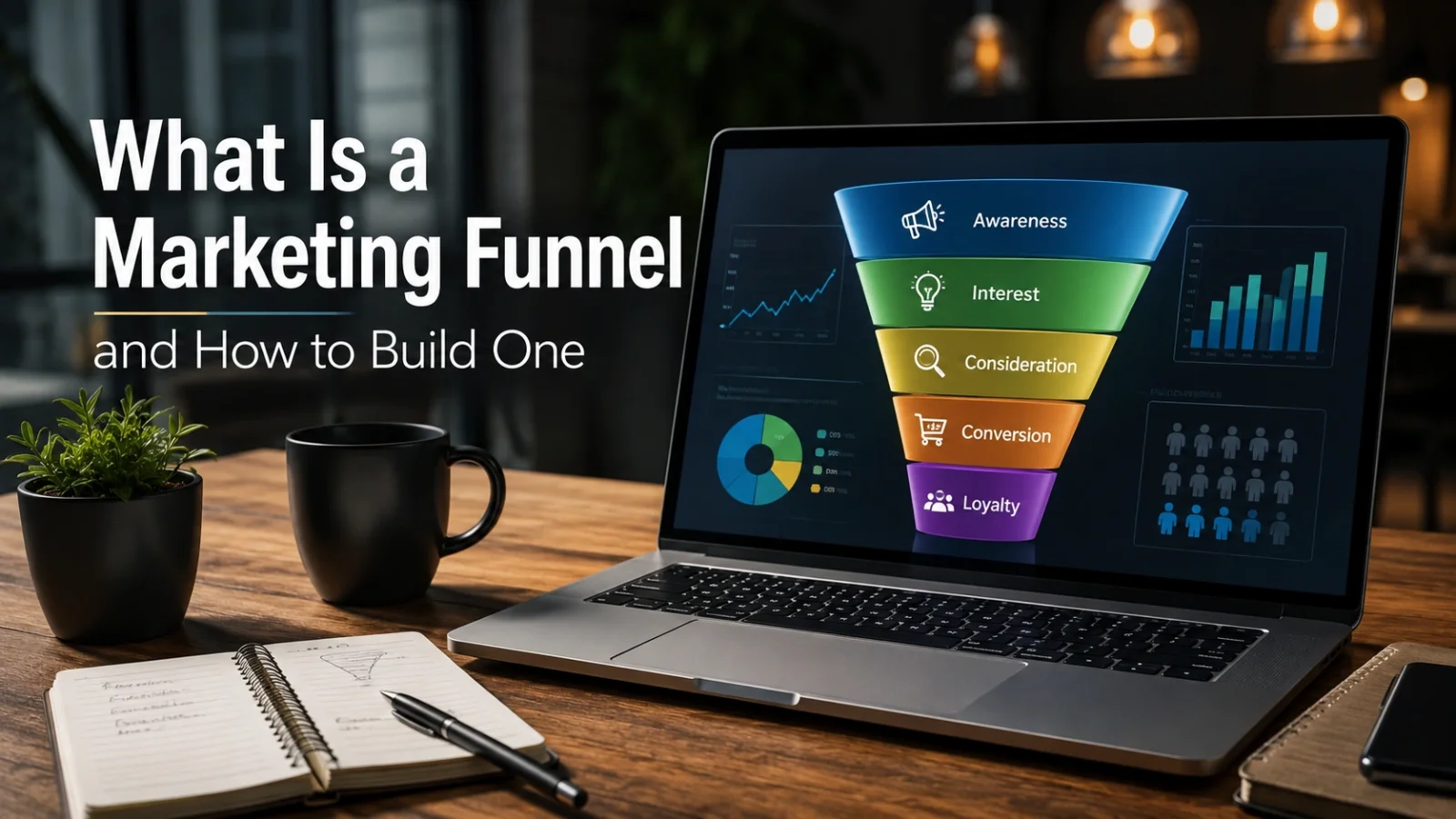
A marketing funnel helps you identify where potential customers are being lost between first discovery and repeat business.
The four stages of a marketing funnel
The customer discovers the business
SEO, social media, advertising, referrals, video and content introduce the brand to potential customers.
The customer evaluates whether to trust you
Service pages, case studies, pricing, reviews, comparisons and FAQs help reduce uncertainty.
The customer takes the desired action
Purchases, bookings, quote requests, trial registrations and signed agreements occur at this stage.
The relationship continues after the sale
Follow-ups, support, reviews, loyalty programmes and repeat-purchase communication help increase customer value.
Where funnels commonly leak
| Stage | Common problem | Potential fix |
|---|---|---|
| Awareness | Too little qualified traffic | Improve SEO, advertising, referrals or content distribution |
| Consideration | Customers do not understand or trust the offer | Improve messaging, proof, pricing clarity and case studies |
| Conversion | Interested visitors abandon the final step | Simplify forms, checkout, CTAs and sales follow-up |
| Retention | Customers purchase once and disappear | Use onboarding, follow-up, loyalty and reactivation workflows |
How to map your real funnel
Walk through the customer journey as if you had never interacted with the business before.
Ask:
How do customers first discover us?
Where do they go next?
Which questions do they have?
What could make them leave?
What action represents conversion?
What happens after the sale?
Document what actually happens today rather than what the team believes should happen.
The gap between the intended customer journey and the real one usually reveals the most important optimisation opportunity.
Match content to the funnel stage
Awareness content should earn attention through educational blogs, short-form videos, social media and advertising.
Consideration content should build trust through case studies, testimonials, comparisons, FAQs and clear service pages.
Conversion content should reduce friction through strong calls to action, transparent next steps and simple forms or checkout flows.
Retention content should maintain the relationship through useful updates, automation, loyalty programmes and follow-up communication.
Where AI automation helps
AI chatbots and voice agents can answer common questions during consideration.
Automated lead follow-ups can support conversion when prospects do not respond immediately.
Email and WhatsApp workflows can continue the relationship after purchase.
Automation is most useful when it prevents customers from being lost simply because nobody responded at the right moment.
Which stage should you optimise first?
Do not assume awareness is always the problem.
A business with very little qualified traffic genuinely may need more reach.
But a business already receiving strong traffic with very few enquiries should investigate consideration and conversion before spending more to attract additional visitors.
Analytics should determine where the largest drop-off occurs.
Frequently asked questions
Is a marketing funnel only for online businesses?
No. The same stages apply to offline and service businesses, although the touchpoints may include phone calls, sales meetings and physical locations.
Do all customers follow the funnel in order?
No. Customer journeys are rarely perfectly linear, but the funnel remains useful for identifying the major decision stages.
Which funnel stage is most important?
That depends on where your business currently loses the greatest number of qualified customers.
Monk Media One builds digital marketing strategies around the complete customer journey rather than measuring success only through clicks, reach and impressions.
Find the stage where your marketing is actually leaking.
Improve the complete journey before simply spending more to increase traffic.
Explore Digital Strategy