
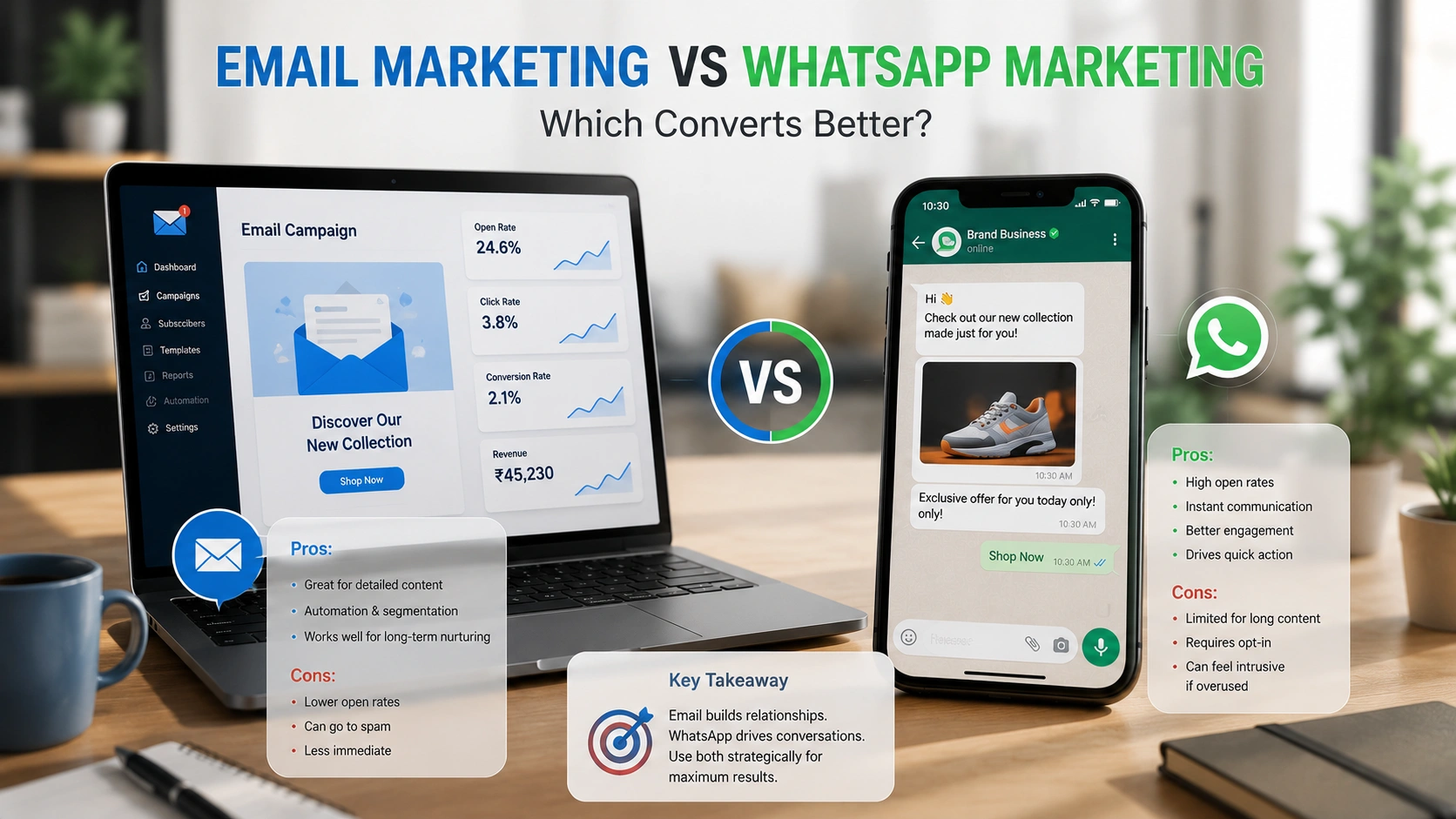
Send the same offer through email and WhatsApp and the difference in customer behaviour can be dramatic.
Email is designed for structured, detailed communication. WhatsApp is designed for immediate, conversational interaction.
Neither channel is automatically better. The strongest option depends on the type of message and the stage of the customer journey.
WhatsApp usually wins on immediacy. Email usually wins on depth, documentation and long-term nurturing.
Email marketing vs WhatsApp marketing
| Factor | ||
|---|---|---|
| Best for | Newsletters, detailed offers, educational content and formal communication | Reminders, support, urgent offers, lead follow-up and conversational sales |
| Customer mindset | Structured and asynchronous | Personal and immediate |
| Message length | Suitable for longer explanations | Better for short, focused communication |
| Automation | Nurture sequences, onboarding and reactivation | Chatbots, reminders, FAQs and transactional workflows |
| Potential weakness | Messages can remain unopened in crowded inboxes | Overuse can feel intrusive and damage trust |
Where WhatsApp performs best
Time-sensitive communication
Appointment reminders, delivery updates and limited offers benefit from immediate visibility.
Lead follow-up
Prospects can respond quickly without moving into a more formal communication channel.
Customer support
Simple questions can be handled conversationally and automated where appropriate.
Transactional updates
Order confirmations, tracking information and booking notifications fit naturally into WhatsApp.
Where email remains stronger
Email is better suited to messages that require more context, formatting or documentation.
That includes newsletters, proposals, educational sequences, detailed product updates, invoices, receipts and longer-form storytelling.
Email is also less intrusive for customers who do not want frequent promotional communication inside a personal messaging application.
Why the strongest strategy often uses both
The goal should not be to force every message into one channel.
A customer might receive a detailed proposal by email and then receive a short WhatsApp reminder two days later.
An e-commerce store could send educational product content through email while using WhatsApp for order tracking and abandoned-cart reminders.
Use each channel according to the context in which the customer is most likely to respond comfortably.
Where automation fits
WhatsApp automation is useful for FAQs, appointment scheduling, order tracking, lead qualification and follow-up workflows.
Email automation is stronger for onboarding, education, reactivation and longer nurturing sequences.
When both systems are connected to the same CRM, businesses can coordinate messages instead of sending disconnected campaigns.
Consent matters
Both channels require responsible permission-based marketing.
WhatsApp promotional messaging should use proper opt-in and approved business messaging systems. Email campaigns should also provide clear consent and unsubscribe options.
More messages do not automatically create more conversions. Relevance and timing matter more.
Frequently asked questions
Should WhatsApp replace email marketing?
No. The channels solve different communication problems and usually perform better when used together.
Which is better for lead follow-up?
WhatsApp can be particularly effective when prospects already use it naturally to communicate with the business.
Which is better for newsletters?
Email remains more suitable for detailed newsletters, educational content and structured long-form communication.
Monk Media One builds integrated email and WhatsApp marketing workflows with segmentation, automation and conversion-focused follow-up systems.
Use the right message on the right channel.
Connect email, WhatsApp and automation around one customer journey.
Explore Marketing Automation