
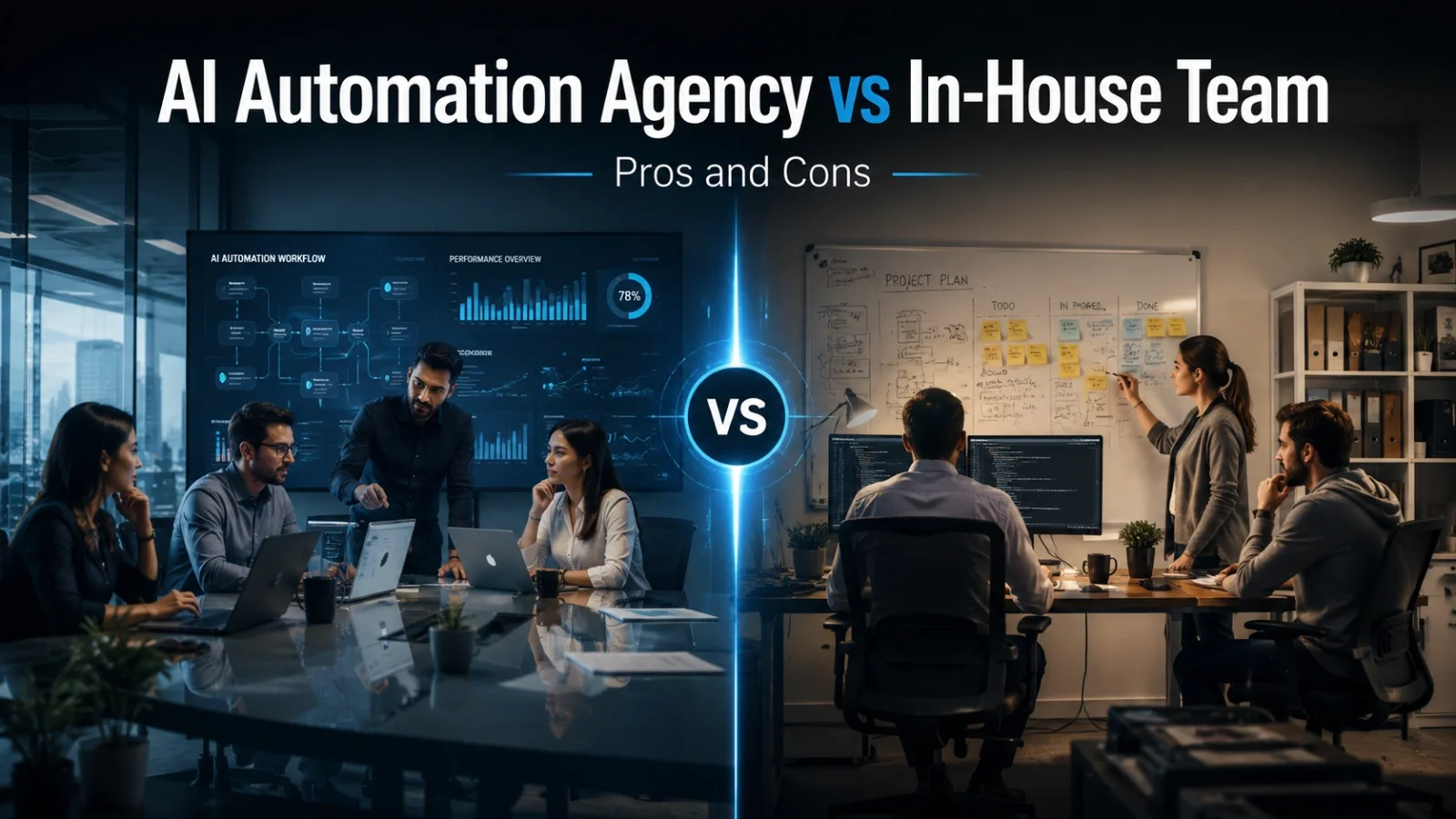
Hiring an in-house automation specialist may cost several lakhs per year before tools, infrastructure and management time are considered.
An agency can often build several workflows for less, but cost alone should not decide the model.
The real question is whether automation is supporting the business—or becoming a core part of the product itself.
Agency vs in-house automation
| Factor | Agency | In-house |
|---|---|---|
| Initial cost | Usually lower for a limited number of projects | Higher because of salary, hiring and infrastructure |
| Speed | Often faster for common workflows because patterns already exist | Depends heavily on the individual hire and onboarding |
| Specialisation | Access to multiple tools and disciplines | Deep knowledge of the company and internal systems |
| Flexibility | Easy to scale project scope up or down | Fixed internal capacity |
| Ownership | Requires clear documentation and account ownership | Knowledge stays closer to the business |
| Best fit | Validation, operational workflows and limited automation demand | Continuous product development and strategically critical systems |
When an agency makes more sense
An agency is often the better starting point when the business needs a small number of defined workflows.
Common examples include AI chatbots, WhatsApp automation, CRM workflows, lead scoring, customer-support systems and automated reporting.
The agency can often reuse proven architecture instead of learning every platform from the beginning.
When an in-house team becomes stronger
Internal ownership becomes more valuable when automation is deeply connected to the company's product or daily technical roadmap.
An in-house specialist makes more sense when systems require frequent development, deep codebase knowledge or continuous interaction with product and engineering teams.
The more strategically central the automation becomes, the stronger the case for internal ownership.
The common expensive mistake
Businesses sometimes hire an automation engineer before they know which workflows actually create value.
The result can be a costly internal resource spending months experimenting with tools rather than solving validated business problems.
A safer sequence is often:
1. Build the first workflows externally
2. Measure the operational or financial impact
3. Document the systems
4. Hire internally when ongoing demand justifies it
A hybrid model can work well
The decision does not have to remain permanently agency versus in-house.
A business can begin with an agency, validate its automation opportunities and later build an internal team while keeping the agency for specialist work or overflow capacity.
The important requirement is ownership.
Your business should retain access to accounts, data, documentation, workflows, integrations and source code where applicable.
Frequently asked questions
When should a company hire internally?
Internal hiring becomes more practical when there is a continuous automation roadmap and the systems are strategically important to the product or operations.
Is an agency always cheaper?
No. For continuous high-volume development, an internal team may eventually become more economical than ongoing project fees.
Who should own the automation accounts?
The client should retain ownership of critical accounts, data and access credentials wherever possible.
Monk Media One builds AI automation systems with documentation and client ownership so businesses can continue with an external partner or transition systems in-house as they grow.
Choose the automation model that fits your stage.
Validate the workflows first, then decide how much capability genuinely needs to move in-house.
Explore AI Automation